






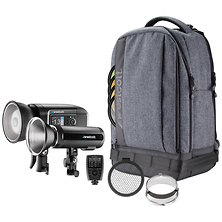
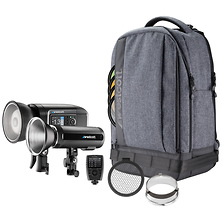
What Monolight Strobe Heads and Kits Give You
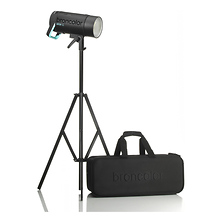
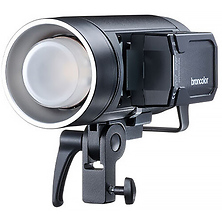
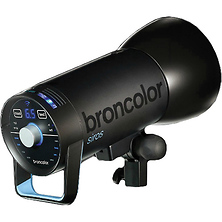
Monolight strobe heads put the flash tube, the power supply, and the controls in one housing that mounts straight to a light stand. You plug in, dial the output, attach a modifier, and shoot. Samy's Camera has carried studio strobe gear since 1976, and our selection covers Profoto, Godox, Broncolor, Elinchrom, and Westcott in single heads and in complete kits, all of it sitting inside our wider strobe lighting range.
A monolight is self-contained. The capacitor bank, the flash tube, the modeling lamp, and the control panel live in one body, so a single power cord and a single stand support the whole light. Everything that holds those heads in position lives in our light stands and grip equipment section.
Watt-Second Output and Recycle Time
Output is rated in watt-seconds, which describes the energy the capacitor stores and releases through the tube. Heads in this category run from roughly 400 watt-seconds through the 1200 watt-second range. Most monolights also adjust down across a range of stops, so a high-output head still works for tight portrait work once you dial it back.
Recycle time is how long a head takes to recharge between full-power pops, and it sets your shooting rhythm. Professional monolights quote recycle figures measured in fractions of a second, which keeps a session moving while your subject holds an expression.
Modeling Lamps
A modeling lamp is a continuous bulb inside the head that shows where the light falls before you fire the flash. It reveals shadow edges, catchlights, and falloff while you are still positioning the stand, which saves test frames. Modeling lamps are replaceable, and we stock strobe light modeling bulbs for that reason. Some photographers also run a continuous lighting unit alongside a strobe setup when a session covers stills and video.
Modifier Mounts
The mount on the front of the head decides which modifiers fit. Umbrella receivers, softbox brackets, reflectors, grids, and beauty dishes all attach through it, and most manufacturers use a consistent mount across their own line so modifiers carry from one head to the next. Pick heads from the same family when you want one set of softboxes to serve every light in the room.
Sync and Trigger Options
A monolight fires when it receives a signal, and most heads accept more than one way of sending it.
- Radio triggers, with a transmitter on the camera hot shoe and a receiver at the head
- Sync cords running from the camera body to the head
- Optical slave sensors that fire one head when they see another flash
- Built-in wireless receivers that pair with a manufacturer transmitter
Radio triggering is the common choice on a working set. Wireless systems from these manufacturers also let you change power on every head from the camera position, so you adjust a ratio without walking back to the stand. If speedlights are part of the same shoot, our flashes and accessories section covers those triggers.
Studio Power and Location Power
In a studio, a monolight runs on wall power and stays where you put it. On location, some monolights accept an external battery pack, and some are built around an internal battery so they run away from an outlet entirely. For work that lives outside a studio, our portable strobe lighting kits arrive packed for travel.
What Comes in a Monolight Kit
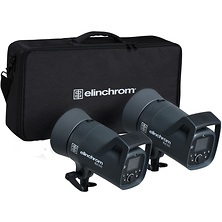
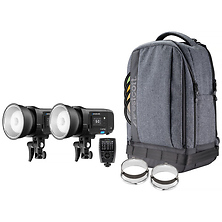
Kits bundle the pieces that make a light usable the day it arrives. Contents vary by brand, and most include:
- Two or three monolight heads
- A softbox, umbrella, or reflector for each head
- Light stands
- A wireless trigger and transmitter
- Power cords and sync cables
- A carrying case or roller bag
A kit removes the guesswork, since the modifiers already fit the heads and the trigger already pairs. Single heads suit a photographer adding to a setup already in use.
Who Uses Monolight Strobe Heads and Kits
Portrait photographers make up the largest group. A two or three light setup covers headshots, family sessions, and senior portraits, and the modeling lamps make it quick to place a key light on a face.
Product and commercial shooters lean on monolights for repeatability. Stored power settings and consistent color temperature mean frame two hundred matches frame one on a catalog shoot running across several days. Event and school photographers build a temporary studio, shoot volume, then break it down, so kits with a case and stands included suit that pattern.
Frequently Asked Questions
How many monolights do I need to start?
One head, one stand, and one softbox will take you a long way, since a single light with a reflector on the shadow side produces clean portrait lighting. Most photographers add a second head for background or hair light once they are comfortable, then a third for separation. Buying from the same family keeps your modifiers and trigger working as the setup grows.
What does watt-second output change in my photos?
Watt-seconds set how much light is available, which in turn sets your working aperture, your distance from the subject, and how much diffusion you can put in front of the head. A 400 watt-second head is comfortable for one or two subjects with a softbox placed close in. More stored energy gives you headroom to move the light back, stack diffusion, or shoot a group at a smaller aperture.
Do monolights work outdoors?
Yes, with the right power source. Battery powered monolights and heads that accept an external pack run anywhere, and they carry enough output to balance flash against daylight when you want detail in the sky behind your subject. Our portable strobe lighting selection covers heads designed around that shoot.
Can I use my existing softboxes with a monolight?
That depends on the mount. Modifiers attach through a standard specific to a manufacturer or to a widely shared design, and many brands sell adapter rings so a modifier from one system fits a head from another. Confirm the mount on both pieces before ordering, and our staff can check compatibility with you.
How do I trigger monolights from my camera?
Most photographers use a radio trigger, with a transmitter on the camera hot shoe talking to a receiver at each head. Sync cords suit a fixed setup, and optical slaves let one head fire the rest when they see the first flash. Many monolights include a wireless receiver in the body, so you only add the matching transmitter.
Why does a modeling lamp matter?
Because it shows the light before you take the picture. Flash duration is far too short to see, so positioning without one means working through test frames. With a modeling lamp running, you watch the shadow move across a face as you move the stand, and your camera has something to focus on in a dim studio.
Shop Monolight Strobe Heads & Kits at Samy's Camera
Our staff shoot with this gear, so we can talk through output, mount standards, and trigger systems for the work you actually do. Browse the full studio and lighting department online, visit a Samy's location to see a modifier on a head in person, or call us to spec a setup for your space.