






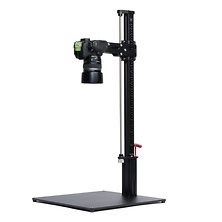
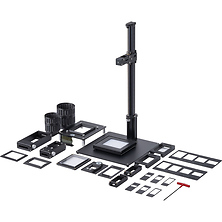
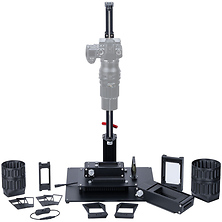

Copy Stands for Film Scanning and Flat Art Reproduction
Copy stands hold your camera on a rigid vertical column above a flat baseboard, aimed straight down at whatever sits beneath it. That geometry solves a problem every photographer meets: keeping the sensor parallel to a flat original so the corners stay sharp and the edges stay square. Digitizing a shoebox of 35mm negatives comes down to framing you can repeat exactly.
A copy stand turns a camera you already own into a digitizing tool. The column holds the lens axis square to the baseboard, the carriage locks the camera at a set height, and the base mass damps the vibrations that soften fine detail during longer exposures. With the geometry fixed, you can work through a stack of negatives without re-aiming each time. Our studio and lighting department stocks copy stands alongside the lights and grip that go with them.
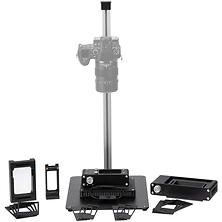
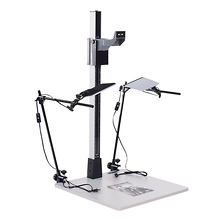
The setups we carry cover two jobs. Film scanning rigs pair a riser with a film carrier and a backlight so a digital body can capture 35mm, 120 roll film, and sheet film. Reproduction stands mount over a gray baseboard with lights on side arms for artwork, book pages, coins, and textiles.
How a Copy Stand Works
Every copy stand shares the same three parts. A weighted base resists tipping and absorbs vibration. An extruded aluminum column carries a scale so you can return to a height you used before. A carriage rides that column with a 1/4 inch 20 thread for the camera, locking by lever or on a geared crank.
Column height sets your working range. Risers in the 20 to 30 inch range cover film formats and small originals with a macro lens. Columns near 42 inches leave room to back the camera off for larger flat art. Load rating matters too, since a body, macro lens, and L bracket add up.
- Weighted aluminum or steel base plate, with kit baseboards up to 23.5 inches square
- Extruded aluminum column with engraved scales in inches and centimeters
- Carriage with a 1/4 inch 20 thread for direct camera mounting
- Lever locking or geared elevation with micro adjustment
- Matte 18 percent gray baseboard, often with a printed alignment grid
- Load ratings sized for a camera body with a macro lens attached
- Film carriers sized for 35mm, 120, 4 x 5, and 8 x 10 originals
- Side arms and backlights with high color rendering
Copy Stand Kits and Risers We Stock
Negative Supply builds film scanning risers around solid aluminum base plates and machined columns, with geared height adjustment and an engraved scale for dialing in the same position each time you change format. Their curated kits bundle a riser with format specific film carriers.
Smith-Victor approaches the category from the reproduction side. Their copy stand kits use an anodized aluminum column with scaled index marks, a matte 18 percent gray baseboard with a printed grid, and a carriage with a quick slide self locking lever. Kit versions add LED copy light panels on adjustable arms, cool enough for delicate documents.
Lighting and Color for Copy Work
Reflective originals want even light from both sides at roughly 45 degrees. At that angle the specular reflection bounces away from the lens, so you record surface texture without a glare patch. Our continuous lighting selection covers panels that mount to copy stand arms, and light stands and grip equipment fills in arms, clamps, and booms.
Film works the opposite way. Light passes up through the negative from a flat backlight, so the color quality of that source sets the ceiling on capture accuracy. A reference target shot under your own copy lights, plus a calibrated display through color management tools, takes the guesswork out of matching a file to the original.
Who Uses Copy Stands
Film photographers make up the largest group. Camera scanning gives you resolution that scales with the body you own, and it turns a roll of 35mm or 120 into edited files the same afternoon. Anyone with a shelf of film cameras and decades of negatives has a real archive project waiting.
Artists, galleries, and museums photograph paintings, prints, and documents for catalogs, insurance records, and licensing. Flat work asks for square geometry and faithful color, which a fixed column and matched side lights deliver. Sellers of coins, stamps, trading cards, and jewelry run the same setup for listing photos. Both tend to start with a digital mirrorless camera they already own and a flat field macro option from our lenses department.
Frequently Asked Questions
What camera do I need for a copy stand?
Any digital body with a 1/4 inch 20 tripod socket mounts to a copy stand carriage. Resolution drives how much detail you record, so megapixel count is worth checking against your original size. Live view with focus magnification helps, since you want sharpness confirmed in the corners of one flat plane.
Which lens suits copy stand work?
A flat field macro lens is the standard choice, because flat field designs hold focus from center to corner across a plane. For 35mm film at a 1:1 reproduction ratio, focal lengths from 50mm to 105mm work well on full frame. Larger originals are captured at a reduction ratio, so the lens choice follows the working distance your column allows.
How tall a column do I need?
Match the column to your largest original and longest lens. Digitizing 35mm and 120 film with a macro lens works within about 20 to 30 inches of rise. Artwork up to 16 x 20 inches uses the distance a 42 inch column provides.
Do copy stands come with lights?
It depends on the configuration. Kit versions bundle LED panels on adjustable side arms, angled for the baseboard they ship with. Riser style stands built for film scanning pair with a backlight instead, since film is lit from underneath. Stand only versions leave the lighting choice to you.
Can I photograph three dimensional objects on a copy stand?
Yes, within the clearance between the baseboard and the camera. Anything that sits flat and fits under that gap photographs cleanly: coins, watches, small tools, jewelry, and packaging laid down. Setups that call for side or three quarter camera angles are handled on tripods and heads instead.
How do I keep captures consistent across a long session?
Set the column height once, note the scale reading, and leave it. Shoot tethered or with a remote release so nothing touches the camera between frames, and lock exposure, white balance, and focus to manual. Raw files on a fast card give you headroom for batch corrections, and our memory and storage selection covers the cards and drives.
Shop Copy Stands at Samy's Camera
Samy's Camera has outfitted West Coast photographers since 1976, and copy work is a job where a short conversation saves a lot of trial and error. Tell us which formats you are digitizing, which camera you own, and how large your originals run, and we will point you to the combination that fits.